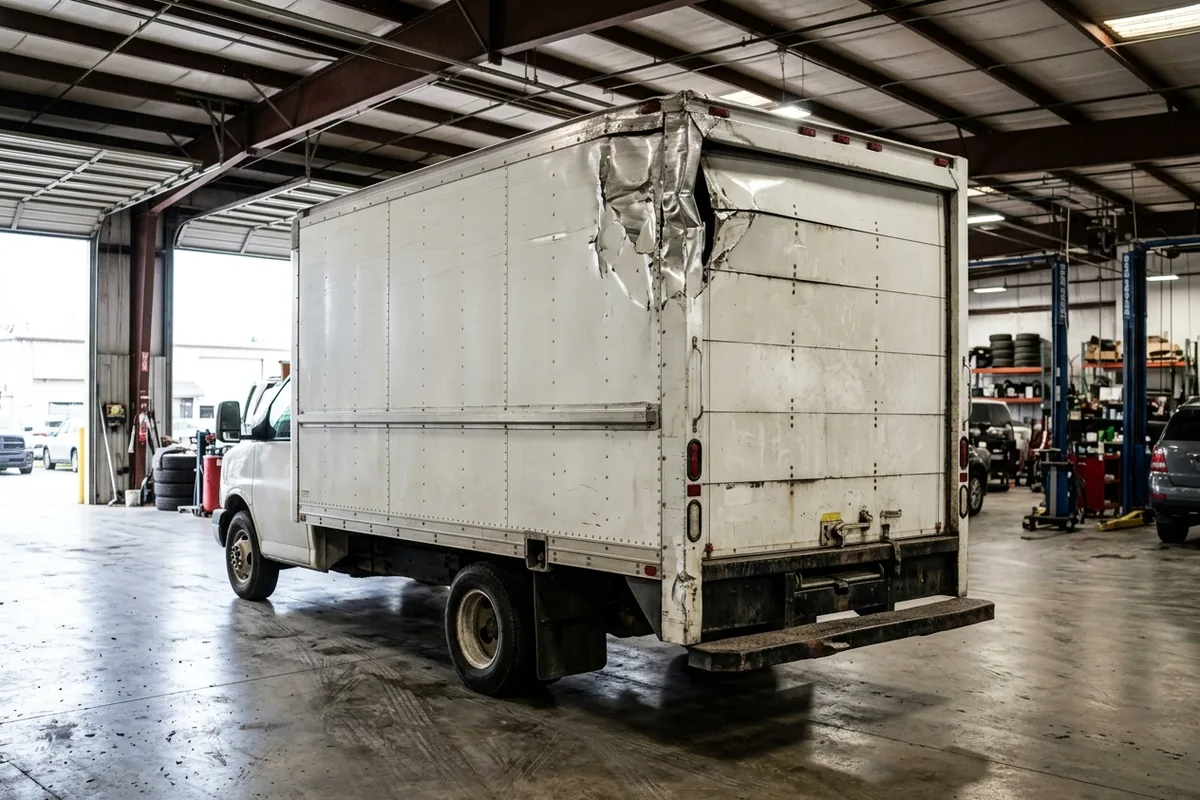
The short answer: Box truck body repair is usually two jobs in one. The cab and chassis are repaired much like a large pickup: the shop checks the frame, replaces or straightens damaged parts and refinishes the paint. The cargo box is a separate structure, built from panels, posts, rails and a rear door, and most box damage is fixed by replacing the damaged sections rather than the whole body. A good shop inspects both halves, tells you which parts it handles in-house and which go to a specialist, and plans the work so the truck spends as few days off the road as possible.
This guide explains what usually gets damaged, what can be repaired or replaced, who fixes what, and how to keep the claim and the downtime under control.
Why a box truck is two repair jobs in one
A box truck (also called a straight truck or cube truck) is a cab-and-chassis truck with a cargo body mounted on the frame. Most fall in the medium-duty range. Under the federal weight classes, Classes 3 through 6 cover a gross vehicle weight rating (GVWR) of 10,001 to 26,000 pounds, and Classes 7 and 8 are heavy duty, according to the U.S. Department of Energy’s vehicle weight class chart. Many delivery and moving trucks are Class 4 to 6.
That construction matters in the body shop:
- The cab and chassis are built by the truck manufacturer. Bumpers, hoods, fenders, cab corners, lights and the frame rails are repaired with the same steps as any collision repair: measure, straighten or replace, then refinish.
- The cargo body is built by a separate body manufacturer and bolted to the frame. It is usually made of aluminum sheets riveted to posts (sheet-and-post), fiberglass-reinforced plywood (FRP) panels, or insulated panels on refrigerated trucks. These materials are repaired with different tools and methods than a car’s steel or aluminum panels.
Because the two halves are built differently, a shop that only fixes cars may be able to repair the cab but not the box, and a trailer shop may fix the box but not refinish the cab to a factory match.
What usually gets damaged in a box truck collision
Box trucks are tall, long and have big blind spots, so most damage comes from backing, tight turns, low clearances and loading docks, not just road collisions. The parts that take the most hits are:
- Front corner caps and upper corners of the box, from clipping awnings, trees and low structures.
- Roof panels and roof bows, from low-clearance strikes such as drive-throughs, parking structures and overpasses.
- Side panels and posts, from sideswipes, poles and other vehicles in tight lots.
- The rear frame, roll-up door and door tracks, from backing into docks, walls and other trucks.
- The rear bumper, rear guard and step, which absorb most low-speed backing impacts.
- Liftgates, which stick out behind the truck and are easy to strike.
- Floor and crossmembers, which can bend in rear impacts or when a heavy load shifts.
- The cab, hood and front bumper, in road collisions, just like any other vehicle.
- Marker, clearance and tail lights, which break easily and must work before the truck goes back into service.
A hard hit to the box can also shift it on the frame or bend the frame rails. Look for the same signs of frame damage after a crash you would on a car: a box that no longer sits square, doors that bind, uneven gaps and odd tire wear.
Repair or replace? A part-by-part guide
Every truck is different, and the shop’s inspection decides the final plan. This table shows how each type of damage is commonly handled:
| Damaged part | Often repaired when… | Often replaced when… |
|---|---|---|
| Aluminum side or roof sheet | The dent or tear is small and the posts behind it are straight | The sheet is creased, torn over a large area, or the posts are bent; the damaged section is drilled out and a new sheet is riveted in |
| FRP side panel | The damage is a small puncture or surface crack | The plywood core is broken, soaked or delaminated |
| Corner caps | Small cracks in a fiberglass cap can be repaired and refinished | The cap is shattered or bent; caps are usually bolted or riveted parts |
| Posts and roof bows | Rarely; bent supports weaken the box | Bent or cracked; usually replaced so the panels sit flat again |
| Roll-up door | A single dented panel, a worn roller or a loose cable | The door is bent out of its tracks or several panels are damaged |
| Rear frame and door tracks | Minor bends can sometimes be straightened | The frame is pushed out of square, so the door won’t seal or roll |
| Floor and crossmembers | A surface gouge in the floor | Crossmembers are bent or the floor is cracked through |
| Cab panels and bumper | Like any car part: dents in sound metal | Torn, kinked or heavily creased parts |
| Lights and reflectors | Never; broken lenses let in water | Cracked, broken or not working |
Two rules of thumb help. First, damage to the box’s skeleton (posts, bows, rails, crossmembers) matters more than damage to the skin, because a bent support pulls everything around it out of line. Second, refrigerated bodies need extra care: a puncture can let moisture into the insulation, so a patch that looks fine outside may still lose cooling performance.
Who fixes what: body shop, door and liftgate specialists, mechanics
On a car, one body shop usually handles the whole repair. On a box truck, the work is often split:
- The collision and body shop handles the cab, frame checks, box panels, corner caps and the paint, including matching factory colors and redoing fleet graphics.
- Roll-up door and liftgate specialists often handle door springs, operators and liftgate hydraulics or electrical repairs. Some body shops do this in-house; others coordinate it for you.
- A truck mechanic handles anything mechanical the crash damaged, such as cooling, steering, suspension or air and brake lines.
When you call a shop, ask which of these parts it repairs in-house and which it sends out, and who will manage the schedule if more than one company is involved. One point of contact saves days.
Size also matters. A box truck needs a bay, a frame setup and a spray booth big enough to fit it. At Cutting Edge Collision Center, our 19,000 sq ft facility has a 45-foot paint spray booth, and our truck body repair in Tucson includes fiberglass front-end repair, aluminum panel replacement, and factory-match or custom paint and graphics.
How to keep the truck’s downtime short
Every day a box truck sits in the shop is a day of missed deliveries. These steps make the biggest difference:
- Take photos right away. Photograph the damage, the scene and the other vehicle or object from several angles before the truck is moved.
- Check that it’s safe to drive. Don’t drive a truck with a door that won’t latch, a bent frame, hanging panels, broken lights or a damaged liftgate. Arrange a tow if in doubt.
- Call the shop and your insurer the same day. The sooner the truck is inspected, the sooner parts can be ordered.
- Ask for an itemized estimate and a parts plan. Body parts such as corner caps, door panels and posts may come from the body manufacturer, not the truck dealer. Knowing which parts are slow to arrive helps you plan.
- Approve the work quickly. Waiting on approvals can leave a truck sitting with the work half done.
- Bring the truck in empty, with keys and any lift or door remotes.
- Plan the return. Ask the shop to test the door, liftgate and every light before pickup.
A shop that already works with fleets understands this. We provide fleet collision and body repair built around fast turnaround, along with large, secured, fenced and gated parking for big rigs and help arranging a tow.
Insurance and paperwork for a commercial claim
Commercial claims follow the same basic steps as personal auto claims, but there is usually more at stake, so paperwork matters:
- Report the loss promptly under your policy’s notice rules.
- Keep the photos, police or incident report, driver statement and repair estimate together so the adjuster can review the claim quickly.
- Expect the estimate to change once panels come off. Hidden damage behind the box skin or under the cab is common, which is why estimates can grow after teardown.
- Ask your agent what your policy covers for downtime or a rental truck. Coverage for loss of use varies widely between commercial policies.
- You choose the shop. Arizona law (A.R.S. § 20-468) gives a person the right to choose any repair facility for a motor vehicle loss. Learn more about your right to choose a repair shop in Arizona.
We provide itemized damage reports for insurance claims, work with all insurance companies, and keep you updated from start to finish. Our repairs are backed by a lifetime warranty on workmanship and materials.
Box truck body repair FAQ
Can a body shop repair a box truck?
Yes, if it has the space and equipment. A box truck needs a bay, frame equipment and a spray booth large enough for the vehicle, plus experience with aluminum, fiberglass and FRP panels. Some shops that work only on cars can’t fit a box truck in their booth.
Is it better to repair or replace a damaged box?
Most box damage is repaired by replacing the damaged panels, posts, corner caps or door, not the whole body. Replacing the full box usually only makes sense when the floor, rails and much of the structure are damaged, or when repair costs approach the value of a new or used body.
How long does box truck body repair take?
It depends on the damage, parts availability and insurance approval. A few panel replacements can move quickly, while frame work or parts that ship from a body manufacturer take longer. Ask the shop for an estimated timeline once it has inspected the truck and checked parts.
Do I need to repaint the whole box after a panel replacement?
Not usually. The new panel is painted and blended to match, and fleet graphics or lettering are replaced on the repaired area. Matching a sun-faded box can take extra care, so ask whether the shop does color matching and graphics in-house.
Get your box truck back on the road
If your box truck, delivery van or other commercial vehicle has body damage, Cutting Edge Collision Center can inspect it, document the damage for your insurer and give you a clear repair plan. Request an Estimate or call us at (520) 624-2787. We’re at 350 E Irvington Rd in Tucson.
Get a Free Estimate
Contact us today for a no-obligation estimate. We work with all insurance companies.