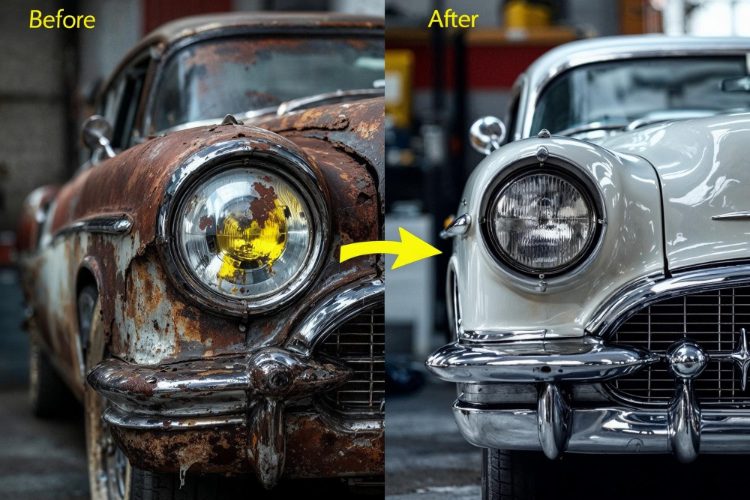
You’ve inherited grandpa’s 1967 Mustang that’s been sitting in a barn for 20 years, or maybe you just bought a “project car” that needs more than a simple paint job. The term “full auto body restoration” gets thrown around Arizona car shops constantly, but what does it actually mean for your vehicle and your wallet?
A full auto body restoration involves completely disassembling a vehicle and rebuilding it from the ground up, including frame repair, body panel replacement, mechanical overhaul, interior refurbishment, and complete paint refinishing. This comprehensive process typically takes 1,000 to 2,000 hours of labor and costs between $40,000 and $150,000 for most classic cars.
Understanding the difference between restoration levels can save you thousands of dollars and months of frustration. Many Tucson car owners mistakenly ask for “restoration” when they really need cosmetic repair work, while others underestimate what true restoration requires.
Frame-Off vs. Body-Off Restoration: What’s the Difference?
The depth of your restoration project starts with this critical decision. Frame-off restoration means removing the entire body from the chassis, allowing technicians to access and repair every component. This process takes 6-12 months minimum and suits vehicles with significant rust damage or those destined for car shows.
Body-off restoration keeps the body and frame together but still involves extensive disassembly. Most Arizona restoration shops recommend this approach for vehicles with solid frames that need comprehensive mechanical and cosmetic work. It typically costs 30-40% less than frame-off work while still delivering exceptional results.
Your choice depends on three factors: the vehicle’s current condition, your end goals, and your budget. A 1970 Chevelle with Arizona surface rust might only need body-off work, while a Michigan car with frame rot requires the full frame-off treatment. At Cutting Edge Collision’s restoration facility, technicians perform a detailed inspection to determine which approach makes financial sense.
What Does Full Restoration Actually Include?
A genuine full restoration touches every system in your vehicle. This isn’t just fixing what’s broken; it’s returning or upgrading everything to showroom condition or better.
Body and Paint Work
The body restoration phase consumes 40-50% of total project time. Technicians strip the car to bare metal, cut out rust, fabricate replacement panels when originals aren’t available, and ensure every gap and alignment matches factory specifications. Modern shops use laser measuring systems to achieve tolerances within 2mm.
Paint preparation alone takes 100-200 hours. This includes metal treatment, primer application, block sanding through multiple grits, sealer coats, base color, and clear coat. High-end restorations receive 8-10 coats of clear, each wet-sanded between applications.
Mechanical Systems Overhaul
Engine rebuilding forms the heart of mechanical restoration. This means complete disassembly, machining of blocks and heads, replacing all wear items, and often upgrading to modern materials. A properly rebuilt engine should last another 100,000 miles.
Transmission, differential, suspension, steering, and brake systems all receive similar treatment. Many owners choose this phase to upgrade to disc brakes, electronic ignition, or overdrive transmissions for better daily driving characteristics. Our comprehensive service menu covers all mechanical restoration needs.
Interior Refurbishment
Interior restoration goes beyond new seat covers. It includes rebuilding seat frames and springs, restoring or replacing dashboards, reconditioning gauges, replacing all weatherstripping, restoring or upgrading sound systems, and refinishing all chrome and stainless trim.
Original-style materials can be surprisingly expensive. A correct seat fabric for a 1969 Camaro runs $300 per yard, and you’ll need 8-10 yards. Complete interior kits range from $3,000 for basic replacements to $15,000 for concours-correct restorations.
Restoration vs. Refurbishment vs. Repair: Know What You’re Buying
These terms aren’t interchangeable, despite what some shops claim. Understanding the distinctions protects you from miscommunication and potential legal issues.
Restoration means returning a vehicle to original or better condition through complete disassembly and rebuilding. Every system gets addressed, not just visible problems. This process typically takes 6-18 months and costs five figures minimum.
Refurbishment focuses on cosmetic and functional improvements without complete disassembly. Think new paint over properly prepared existing surfaces, interior refresh with quality aftermarket parts, and mechanical repairs to make the car reliable. Most “driver quality” classic cars fall into this category.
Repair addresses specific problems without attempting comprehensive improvement. If your classic needs collision damage fixed or rust spots addressed, that’s repair work, not restoration. Check our project gallery to see examples of each service level.
What’s the Average Cost for Full Auto Body Restoration in Arizona?
Arizona restoration costs vary wildly based on vehicle rarity, parts availability, and desired finish quality. Here’s what local shops typically charge in 2026:
Driver-quality restorations run $40,000 to $70,000. These cars look great from 10 feet away, drive reliably, and use quality aftermarket parts where appropriate. Perfect for cruise nights and weekend drives.
Show-quality restorations cost $70,000 to $120,000. Every detail matches factory specifications, paint finish rivals modern luxury cars, and documentation proves authenticity. These win regional car shows.
Concours restorations exceed $120,000, often reaching $200,000 for rare vehicles. Every bolt, clamp, and decal matches what rolled off the assembly line. These compete at Pebble Beach and similar venues.
Labor rates for quality restoration work in Tucson and Phoenix range from $85 to $125 hourly. Parts typically equal or exceed labor costs, especially for rare vehicles. According to Classic Cars Journal’s 2026 pricing survey, Arizona ranks middle-of-the-pack nationally for restoration costs.
How Long Does Complete Auto Restoration Take?
Realistic timelines prevent disappointment. Full restorations rarely finish in under six months, regardless of shop promises. Most take 12-18 months from start to finish.
Frame-off restorations average 1,500 to 2,000 labor hours. With one technician working full-time, that’s 9-12 months. Most shops juggle multiple projects, extending timelines further. Add parts ordering delays, custom fabrication time, and paint curing periods, and 18 months becomes common.
Partial restorations or refurbishments typically complete in 3-6 months. Simple cosmetic work might finish in 4-8 weeks. Always add 25% to any timeline estimate for unexpected discoveries. That “small rust spot” often hides major structural damage.
Frequently Asked Questions
What’s the difference between frame-off and rotisserie restoration?
Rotisserie restoration places the separated body on a rotating stand after frame removal, allowing 360-degree access for more thorough rust repair and coating application. It adds $3,000-5,000 to frame-off costs but ensures complete coverage of rust preventatives and produces superior paint results in hidden areas.
Can I restore a car that’s not considered “classic”?
Absolutely. Any vehicle can be restored, though parts availability and cost-to-value ratios vary significantly. Modern cars from the 1990s and 2000s are increasingly popular restoration candidates, especially Japanese sports cars and European luxury vehicles. The process remains similar, though computer systems add complexity.
How do I verify a shop actually performs full restorations?
Request to see current projects in various stages, ask for photo documentation from previous builds, verify they have proper equipment like frame machines and spray booths, and contact previous customers. True restoration shops gladly show their work. Be suspicious of shops that only show finished cars or resist facility tours.
Should I buy a “restored” car or restore one myself?
Buying restored saves time but requires careful inspection since “restored” has no legal definition. Many sellers call basic refurbishment “restoration.” Restoring yourself costs more than buying but ensures you know exactly what work was performed. Most enthusiasts find middle ground: buying partially restored projects.
What paperwork should I keep during restoration?
Document everything: all receipts, before/during/after photos from multiple angles, parts numbers and sources, paint codes and mix formulas, and technician notes about discoveries or modifications. This documentation can add $10,000+ to resale value by proving restoration quality.
Critical Restoration Decisions Most Shops Won’t Discuss
Beyond the standard restoration checklist, several decisions significantly impact your project’s cost and outcome. Smart owners address these before work begins.
Matching numbers matter for value. If your engine block doesn’t match the VIN, a complete restoration might not make financial sense. Non-matching cars typically sell for 30-40% less than documented originals. Consider refurbishment instead.
Modern upgrades versus originality creates constant tension. Air conditioning, power steering, and electronic ignition make classics more enjoyable but can hurt value. Document and preserve original parts even when upgrading. Future owners might want authenticity.
Parts sourcing strategy affects both cost and timeline. Original manufacturer parts cost 3-5 times more than quality reproductions but might be necessary for show cars. Establish your quality standards early. Switching mid-project wastes money and time.
Insurance during restoration requires special attention. Standard auto policies won’t cover your $50,000 investment in a car worth $5,000 pre-restoration. Specialty insurers like Hagerty offer agreed-value policies for projects in progress.
Is Full Restoration Worth It for Your Vehicle?
Not every car deserves full restoration. The decision depends on emotional value, financial reality, and intended use.
Financially, restoration rarely makes sense. Spending $80,000 to restore a car worth $60,000 finished seems irrational. Yet restoration isn’t about profit for most owners. It’s about preserving history, fulfilling dreams, or honoring memories.
Consider your car’s rarity and desirability. Common vehicles like 1980s Camaros rarely justify full restoration costs. Rare or significant cars warrant the investment. A numbers-matching 1969 Plymouth Barracuda? Absolutely. A base-model 1983 Oldsmobile Cutlass? Probably not.
Your intended use matters too. Daily drivers don’t need concours restoration. Weekend cruisers benefit from quality refurbishment. Show cars demand full restoration. Match your investment to your goals.
Ready to explore restoration options for your classic vehicle? Our team at Cutting Edge Collision offers free consultations to assess your project’s scope and provide realistic estimates. We’ll help determine whether full restoration, refurbishment, or targeted repairs best suit your goals and budget. Understanding exactly what full auto body restoration includes helps you make informed decisions about your classic car’s future.
Get a Free Estimate
Contact us today for a no-obligation estimate. We work with all insurance companies.